

How long do you want to wait for a website to load? 1, 2, 5 or maybe 10 seconds?
Personally, I’m not an impatient person waiting for something, so I usually leave the website if within 2-3 seconds it still hasn’t loaded.
Therefore, it’s crucial to have a website with fast page load time, you must do best practices to be able to optimize your website speed.
But before stepping there, it’s good to know the reasons why website loading speed is so important? What difference does a fraction of a second make?
The answer is that makes a big difference! It can affect user experience, search rankings, and even conversions & sales.
Let’s dive deeper one by one!
Website Speed is an SEO Factor
The battle to obtain a high ranking on search engines will not ever end. Every single day, countless businesses perform their best to position their websites over competitors. When it comes to this, regular activities need to be accomplished to optimize a website. And one of the remarkably essential factors of Search Engine Optimization (SEO) is enhancing website speed.
Google comes with secrets. Some of them are still unrevealed, and some others have disclosed. What is no longer a secret for SEO players, because of an announcement made in 2010, Google doesn’t like sluggish websites; for that reason, they might get penalties in ranking. Of course, absolutely no business would desire that, otherwise, it’ll be exceeded by competitors who have a website with quicker page loading.
back to menu ↑
Faster Speed = Better User Experience
User experience is everything about producing an extraordinary however simple experience for visitors to your website. The two most crucial aspects of user experience are providing users what they are looking for and giving it fast.
Likewise, keep in mind that first impressions matter!
Visitors will be happy as you’ve made a very good first impression if your website can load quickly. People think about fast websites to be professional and dependable.
Whereas a sluggish website makes people assume it’s unsafe, insecure and untrustworthy. And it’s very tough to be able to change this first impression afterward.
When it comes to user experience, you won’t get a second chance. Nearly 80% of your visitors might not be returning.
So, in case you intend to improve user experience and make an excellent first impression on your website visitors, pay close attention to your website loading speed. Users visiting your site are searching for something, so give it to them as quickly as possible before they decide to head to your competitors.
Right after your visitors are puzzled or frustrated, you’ve done the glitch. And nothing makes all of us frustrated like a slow website!
back to menu ↑
Website Speed Affects Conversions & Sales
The better the user experience, the more you sell. It’s as simple as that.
If most of your prospective visitors are leaving your website because of sluggish loading speed, then that’s driving your conversions and sales away.
So, if you don’t wish to lose income opportunities, take a look at your website’s loading speed.
According to Strangeloop Networks case research that involved Google, Amazon, and other large websites, a 1 second delay in page load time can result in 7% reduction in conversions, 11% less in page views, and 16% decrease in customer satisfaction.
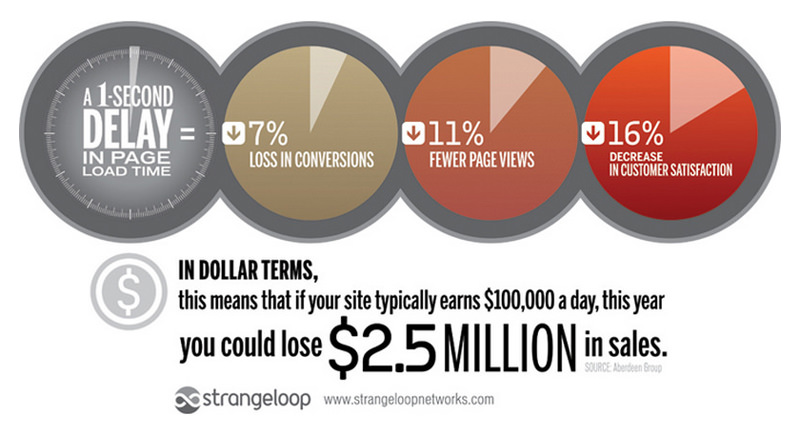
That simply proves how vital website speed actually is in affecting conversions and sales.
back to menu ↑
The Future of The Internet is Mobile
Back in 2015, Google disclosed that mobile devices were producing more online searches than desktop computers. More than 65% of digital media time is represented by mobile devices these days. For publishers, this implies that future growth in regards to users will be straight bound to how well you can serve to the mobile audience.
A critical aspect of mobile-optimization is designing your website with user experience in mind – this will certainly likewise include loading speed. When it comes to website speed, mobile users are known to be particularly demanding. According to a study, practically half of mobile users expect a web page to load in 2 seconds or less, and about 40% will desert a web page which takes more than 3 seconds to load.
Additionally, another research from Google Neural Networks has found that along with mobile page load time goes from 1 second to 10 seconds, the mobile site visitor bouncing probability increases by 123%. Similarly, as the number of elements, such as text, titles, images, etc, on a page goes from 400 to 6,000, the conversion probability drops by 95%.
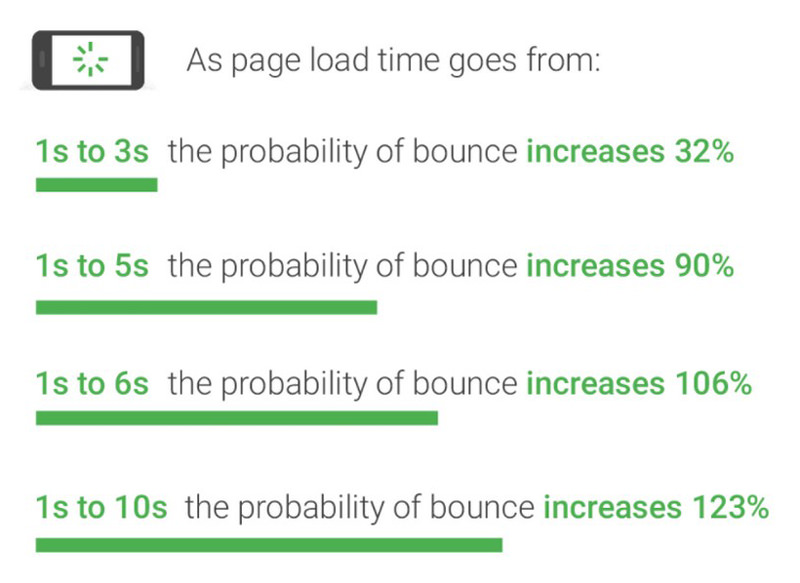
Consequently, in case you plan to build up your website over coming months and years, you’ll also need to plan for the mobile audience in regards to optimal page loading speed.
back to menu ↑
The Long-Term Effect of Slow Website Speed
All of us understand that slow loading speed causes an instant decline in visitors. Virtually half of your prospective visitors have already left. But not only that, there is a long-lasting effect that will unavoidably take place. Long loading time slowly stunts your natural growth and word-of-mouth.
Due to a bad experience, people gradually stop referring your site to others. Established websites are less likely to link back to your content. It might also put people off subscribing to your newsletter.
We often link a sluggish website to a lack of credibility, that might damage your brand in the long run.
So, how fast is your website? How many potential visitors you are losing because of your website’s loading speed?
What is clear, more now than ever before, is that website speed matters. It obviously can affect your user’s experience, your search rankings, your conversions, and ultimately your sales. So, look at your website’s loading speed now and improve where needed by applying speed optimization best practices.
To drastically improve your website speed, read my speed optimization best practices.
I am hoping you found this article helpful!

- Readers Rating
- Rated 5 stars
5 / 5 ( Reviewers) - Spectacular
- Your Rating
Subscribe To Our Newsletter!


Thank you so much for this tips it really helpful.