
Choosing the right web hosting service can be a nerve-wracking experience since hosting can make or break your website. You need to spend hours doing research, trying to comprehend what sounds like gibberish and then comparing one by one the features offered by all these companies.
Still confused to decide which web hosting company you should sign up with? SiteGround and Bluehost each have their pros and cons but which one is the best?
My expert head-to-head comparison will help you make it easier to choose between SiteGround and Bluehost. I’ve done all the necessary testing so you don’t need to do it again and you’ll find an extensive SiteGround vs. Bluehost hosting comparison below to help you choose the best among them.
Affiliate Disclosure: This article contains affiliate links, which means Affapress earns a small commission whenever you end up purchasing products we recommend. However, the opinions written are only based on our experience and not how much they pay. Please continue to support our work and learn more about our affiliate links policy.
1. SiteGround vs. Bluehost (Users Polls & Reviews)
WordPress Hosting is a closed Facebook group with over 10,000 members focused on WordPress hosting solely.
Every year members are asked to vote for their preferred web hosting. Can you figure which WordPress hosting company got the most votes?
That’s right. SiteGround has been voted as #1 WordPress hosting for two years in a row now (#1 in 2017’s poll and #1 in 2016’s poll). It included over 350 voters who are proficient in WordPress hosting.
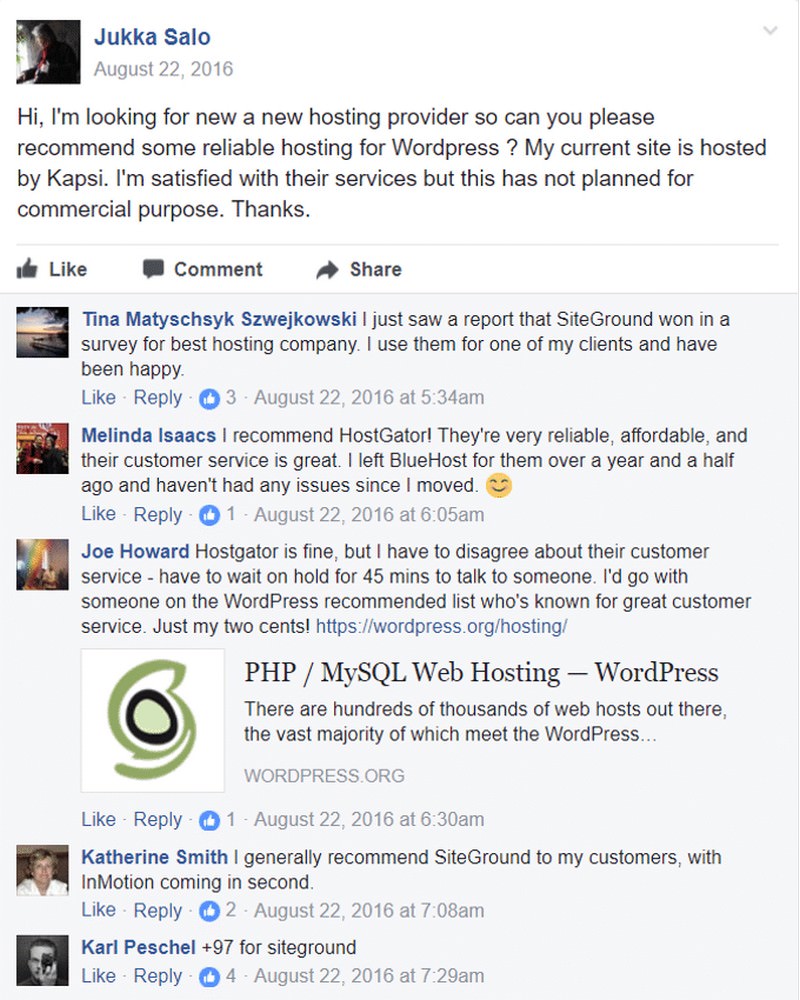
SiteGround was also rated #1 in numerous other polls by various WordPress Facebook Groups (you can click each image to see the poll) while Bluehost was thoroughly nowhere on the map.


In various discussions, there’s also many who recommend using SiteGround.


Ivica runs the WordPress Speed Up Facebook Group and ranks SiteGround #1 on his resources page. Ivica isn’t a SiteGround affiliate or is sponsored by them, he’s just been a customer for many years.


Apart from many polls conducted on Facebook, as shown above, SiteGround also obtains perfect scores and ratings from numerous trusted hosting review sites such as HostAdvice, HostSearch, Trustpilot, etc (you can click each image to see the review).


back to menu ↑
2. Why I Don’t Like Bluehost
- 3-years upfront payment (SiteGround is only 1-year).
- Extremely slow in releasing new PHP versions.
- Owned by EIG who cuts operational costs at the expense of performance.
- Server errors such as bad gateways or internal server errors occur frequently.
- They don’t explicitly list what type of speed/uptime technology they use.
- Built-in SEO isn’t very helpful (completely separate field).
- Continually trying to sell upgrades that aren’t so necessary.
- They don’t support staging and several other advanced features.
- Support was awful (eg. 1 hour response times).
- Support won’t recognize in case servers are causing the problem.
- They are for beginner website users who don’t carry out full research.
back to menu ↑
3. Why I Do Like SiteGround
- They are officially recommended by WordPress.
- They use PHP 7.3 (check your version here).
- They use HTTP/2 servers (check your version here).
- They explicitly list what speed technology they use on their page.
- Average load time is super fast which is 1.3s, giving most people instant speed boosts.
- I frequently get 100% uptimes, but 99.99% is guaranteed.
- Making GTmetrix/Pingdom scores much higher (my biggest reason).
- Consistently become #1 in Facebook polls/discussions (#1, #2, #3, #4, #5, #6, #7).
- Free Let’s Encrypt SSL certificate (EIG companies sometimes charge for this).
- Easy 1-click Cloudflare activation through the cPanel dashboard (view cPanel demo).
- SG Optimizer plugin helps keep your PHP updated with the latest version.
- Managing automatic daily backups, WordPress updates, and security updates.
- Exceptional support (tickets generally answered within <10 min).
- I can call them 24/7 and they happily answer my questions (1.800.828.9231).
- Weekly security email notifications.
- Their semi-dedicated plan is affordable and also much faster than shared hosting.
- Have great eCommerce hosting with cutting-edge features.
- They will migrate your website for free with a 30-day money back guarantee.
back to menu ↑
4. Don’t Waste Your Money on An EIG Company
Bluehost is currently owned by EIG (Endurance International Group) who operates more than 80 different hosting companies including HostGator, Site5, iPage, Unified Layer, etc. They are known for frequently dismissing top employees and cutting costs by downgrading hardware, “streamlining” support and packing too many users on the same server which causes them to be slow and unreliable. Anything owned by EIG – I would stay away from it.

Read this about EIG:


Okay, now I’m going to compare every aspect of SiteGround vs. Bluehost more deeply.
back to menu ↑
5. SiteGround vs. Bluehost – Popularity
Here’s a graph that illustrates the popularity of SiteGround and Bluehost for several years.

Founded in 2003 in Utah, Bluehost is now successfully empowering over 2 million websites and employs more than 750 people. It hasn’t stopped growing rapidly until 2013 when they were finally acquired by EIG. After the acquisition, Bluehost began to receive a lot of bad reviews (just like any other EIG company), and then eventually resulting in low popularity and less growth. In the last 2 years, they only grew 10%, far different compared to 300% growth from SiteGround.
SiteGround was founded in 2004 and now employs more than 400 people. As you can see from the graph above SiteGround in 2016 only hosted around 500,000 websites, but at the end of 2018, they host over 1.8 million websites which is an almost 4x increase in the last 2 years. This Bulgarian company has succeeded in becoming one of the most popular shared hosting services in recent years.
back to menu ↑
6. SiteGround vs. Bluehost – User Interface
SiteGround and Bluehost both provide cPanel-based solutions with many common features (eg., FTP accounts, domain manager, file manager, email accounts, PHPMyAdmin, etc). You can even activate Cloudflare (a popular CDN) on both providers easily.
In my personal opinion, SiteGround’s approach is a bit clearer in presenting the tools and crucial information needed (view cPanel demo).

Bluehost’s backend is a little messed up with constant upsell pitches and promotion of (paid) tools that you most likely don’t need (eg., AppMachine, Weebly, ConstantContact, etc) – this causes a bit of confusion (view cPanel demo).

Winner: Both have an easy-to-use system, and they are quite intuitive. But if I had to pick a winner, I would choose SiteGround.
back to menu ↑
7. SiteGround vs. Bluehost – Hosting Features
There are many features that you should take into account when checking out a hosting provider. But in lots of my experience these are the most relevant for shared hosting:
Storage – How Much Space You’ll Need?
This always becomes the most fundamental factor to take into account. You’ll need to make sure your hosting plan choice has enough storage for your project(s), and a little bit extra.

I must say that 10GB of storage is plenty for most projects unless you’re planning to upload lots of HD images and large videos.
Winner: Bluehost’s entry-level plan (Basic) already offers more storage compared to SiteGround’s higher plan. If you indeed need lots of space, Bluehost can be a better option.
Sidenote: SiteGround utilizes SSD as their storage drives. These are assuredly more expensive but also much faster than traditional hard drives (like the ones Bluehost uses). Similar to comparing a Ferrari with a bus, the first won’t fit more than 4 or 5 people but will be much faster than the latter.
Bandwidth – How Many Visits Will You Get?
This refers to the amount of traffic that your website will be allowed to receive. More often than not, hosting providers try to limit your website visitors, so you’re forced to upgrade your plan to a higher one.
Winner: Good news here! Both SiteGround and Bluehost don’t have any bandwidth limitations – so you can get as much traffic as possible.
Domains, Subdomains & Parked Domains
SiteGround will allow you to create as many subdomains as you need. You’ll also be able to park unlimited domain names with all their plans. However, for a new domain name, they don’t offer it for free upon registration, you’ll be requested to pay for it (or buy it elsewhere) – domain names start around $12 per year.
Bluehost does offer a free domain name with all their plans. Be aware that they limit to 25 subdomains and 5 parked domains with their entry plan, but there are no limitations with the higher plans.

Winner: Since Bluehost offers a free domain name on every purchase on all their plans, this point is for them.
Email Accounts – Receive & Send Emails
SiteGround comes with unlimited email accounts and per account has a maximum space for each plan up to 2GB, 4GB, and 6GB. You can set up forwarders and aliases for each of your accounts. Their cPanel comes with 3 emails clients to conveniently manage your accounts: Horde, SquirrelMail, and RoundCube.

Bluehost offers almost the same – it even uses the same webmail clients. The only difference is Bluehost imposes limits on their entry-level plan (Basic) to 5 email accounts and 100MB of storage. But for their higher plans offer unlimited accounts and storage.

Winner: SiteGround and Bluehost offer almost the same features. In my opinion, both are equally good. Tie!
FTP & SFTP Accounts
Both SiteGround and Bluehost allow you to create FTP accounts as many as you need. Using SFTP is not a problem for SiteGround. Bluehost also allows to use SFTP, but only for the main FTP account.
Winner: Once again they are pretty equal, so one point for each.
SSL & HTTP/2
To improve your website security and SEO rankings, having an SSL enabled (https) and running your website over HTTP/2 can be very helpful. So hosting providers that offer these features out-of-the-box are one step ahead of their competitors.
Winner: Both SiteGround and Bluehost offer free SSL certificates (via Let’s Encrypt) and HTTP/2. There’s nothing to complain about here!
Git & SSH Access
These technologies make programmers easier to deploy and keep track of the changes made (especially when working in teams).
SiteGround has developed their own cutting-edge SSH access system, thus allowing you to be able to gain admin access to your account and that’s extremely convenient for managing big files. On top of that, you can also set up a Git repository to enable version control on your projects – best practice among pros.

While Bluehost also offers SSH access, sadly the Git repository isn’t available with their shared hosting plans.
Winner: This round goes to SiteGround!
WordPress Managing
Most of us use the WordPress platform as the chosen CMS, which is not surprising since WordPress is currently the most popular CMS platform in the world. Therefore having a server optimized for WordPress and tools that enhance productivity can be very great. Let’s check the main WordPress features that you’ll get with both hosting providers:

*Staging area: This is like a sandbox area where you can try out to make code changes without having to affect the production site.
Winner: SiteGround completely wins this one.
Let’s Do A Features Recap
- Both providers offer equally good at: bandwidth, email accounts, FTP & SFTP accounts, SSL & HTTP/2.
- Bluehost is more generous with much larger storage.
- And SiteGround beats out Bluehost at: backup & restore, Git & SHH access, and the WordPress features.
Winner: The hosting features section point falls into SiteGround’s hands too.
back to menu ↑
8. SiteGround vs. Bluehost – Speed
Thanks to their highly efficient servers and static caching, speed is one aspect that works very well on SiteGround. The perfect combination of the most advanced features such as SuperCacher, Memcache, Varnish caching, and CloudFare Railgun, really help boost your website speed significantly.
TTFB (Time to First Byte) refers to how quickly the host’s server sends the first byte of data when responding to a request. This is an important metric since it allows us to be able to test the speed and quality of the servers independent of front-end issues.
The speed at which the server delivers the first byte of data won’t be affected by the website type, it’s size or also other similar factors. So, it can be the most appropriate way to find out the quality of the hosting company’s servers.
From the following tests show that SiteGround had a TTFB of 308 ms, whereas Bluehost’s was 401 ms.


It’s clear that SiteGround is the winner with a significant margin difference in terms of TTFB. Their excellent servers are the main factor, but it might also be due to the number of data centers they have spread across several locations around the world.
Here’s an interesting tweet from one of the SiteGround users. He showed that his website was loaded 2 seconds faster instantly after transferring to SiteGround.
That’s genuinely a remarkable difference!

Load time less than one second for a web page which is 2.0 MB in size is excellent even after optimization.
Here are the results of a speed test from various locations around the world.
Speed of Websites Hosted on SiteGround
SiteGround showed excellent performance in Europe and the US, while it loaded slightly more slowly in Melbourne.

Speed of Websites Hosted on Bluehost
Bluehost performed well in the US and Melbourne but failed to put its mark on Europe.

Here’s a why website hosted on SiteGround is faster than Bluehost:
SiteGround Lets You Choose Your Website Server Location
One of the advantages of SiteGround which is my favorite is that they have more than one data center location. They have 4 global server locations including in the US (Chicago), the UK (London), the Netherlands (Amsterdam), and Southeast Asia (Singapore).

One of the most effective ways to boost your website speed is to place your website’s files on a server located near your target audience. As instance, if your website has most traffic coming from the UK, try to buy a hosting who have their servers in the UK area like London.
Not only that, SiteGround makes it very easy to change server location whenever you want. So, no need to worry in case you still don’t know the location of your audience.

When researching the Bluehost website, there’s not much information explaining their data centers. Furthermore, they don’t allow us to choose a server location even during the initial purchase process.
Here’s one of the reasons why the location of their servers wasn’t disclosed:
…they are undoubtedly a big company, which owns and does use different data centers to utilize optimized infrastructure. So the situation is not very clear. Especially after Endurance International Group (EIG) acquired them – they have expanded their collaboration with many other hosting companies and data centers to continue to look for optimal business solutions and to grow their operations.
Winner: As you can see from the tests above, SiteGround performed way better than Bluehost. So this crucial point goes to SiteGround.
back to menu ↑
9. SiteGround vs. Bluehost – Uptime
Along with the hosting speed, uptime is arguably the most critical performance metric. Uptime is the amount of time your website is up and running to your visitors. There are many chances that allow your website to be inaccessible to your visitors as a result of hardware failure, server maintenance, power shutdown, etc. by your web hosting company. That’s why this test is crucial since less uptime can bring huge losses to your business through loss of credibility, sales, Google rank, etc.
SiteGround and Bluehost are both promising 99.99% uptime guarantee. However, in practice, it shows that Bluehost has some issues with downtime, which leads to an average uptime of less than 99.99% per month.
On the other hand, SiteGround doesn’t indicate any major problems with downtime. In fact, over the past year, their average uptime has reached 100%. This proves that the servers they have are highly reliable and some of the best in the industry.
The test I conducted by using Host Tracker to help monitor roughly 150 SiteGround and Bluehost websites to determine a more accurate figure for their uptime.
To see different estimates for uptime percentage, you can use this Live Hosting Uptime Tracking tool. You can change the date variable to display the interactive graph you want.

The graph above gives you a snapshot of SiteGround’s performance which is slightly better than Bluehost in terms of uptime.
Then to be more convincing, I went deep and tracked the uptime of a personal blog hosted under SiteGround and Bluehost, and the results were as expected.

SiteGround recorded just 5 minutes of downtime during my testing. Meanwhile, Bluehost downtime was 13 minutes.
Winner: SiteGround is the winner here, beating Bluehost with a slight uptime margin.
back to menu ↑
10. SiteGround vs. Bluehost – Security
SiteGround comes with SFTP, SSL, and SSH access, all these features are crucial security-wise. Moreover, they also employ PHP 7.3 which is the latest version (apparently it’s a more secure version), monitoring the traffic to block brute force attacks and updating their security rules regularly every week. They also sell SG Site Scanner which is an add-on to scan your website looking for hidden malware – it costs $1.65 extra a month.

Honestly, Bluehost also offers a similar approach with SFTP, SSL, and SSH access. They don’t share much other information about their security protocols, but they do offer SiteLock which is an external security solution that costs starting at $30 per year.

On the other hand, SiteGround was the first hosting company to implement a unique isolation system that ensures each account on a server is isolated from all others. So if someone else’s website becomes compromised, yours will remain safe.
Websites are secured against hackers because every time you log into cPanel, you’ll be guided into SiteGround’s encrypted server.
Moreover, SiteGround has recently developed an advanced anti-bot AI that serves to protect their customers from brute-force attacks.
The new bot prevention system has given incredible results since it managed to block as many as 2 million attacks across their servers. It not only protects the customer’s websites but also frees up server resources that can now be utilized by customers.
The AI system works by monitoring all SiteGround’s servers simultaneously and analyzing data in depth. Based on the results, it takes its own action automatically to stop malicious bots. Some of the flags which AI watches include:
- Failed logins
- How many simultaneous connections are present to different URLs
- DDoS weaknesses that are already known in different apps
- Various request types that associated with DDoS attacks
- A continuously updating list of blacklisted user agents
When the AI system decides that an IP is malicious, the AI system would block it and gives a challenge through a Captcha page. If the “puzzle” is successfully solved, meaning that it’s indeed a human and not a malicious bot, then the address will be whitelisted. And the AI learns from these situations continuously so that it can reduce the level of false positives that might occur.
Thus, SiteGround’s security system is more reliable in protecting the customer’s websites.
While Bluehost relies on Cloudflare in protecting their customers from DDoS attacks.
Winner: SiteGround wins by a long-shot as they’ve developed their own AI system to block brute-force attacks and doesn’t need to rely on a third party to protect their customers.
back to menu ↑
11. SiteGround vs. Bluehost – Server Quality
To test how the servers of each host will react when getting a large number of simultaneous visitors, I utilized the Load Impact app. This test will show the performance of each host server when there are 50’s of visitors coming at the same time to your website.
Here are some of the steps taken to make sure all tests can be as fair as possible:
- Each website must have a WordPress 4.0 installation running on it, using the same theme, and have the same number of images, page size, content, and requests.
- All existing plugins and catching systems were disabled.
- The test was performed several times, and the best results are displayed here.
- The host servers which I tested are located in Chicago, IL, Provo, and UT, whereas I used servers located in Dallas, TX, Ashburn, and VA, respectively.
The green line indicates the number of visitors, while the blue line represents the contiguous response time when there are increases in traffic.
SiteGround Server Response Time
- My Server Location: Dallas, TX
- Hosting Server Location: Chicago, IL
- Max Response Time: 1.6s
- Minimum Response Time: 650ms
You can see the performance of SiteGround was rock solid, especially considering the price tag of $3.95 for their most basic hosting plan. Their average response time was 650ms all the way to 50 concurrent visitors without any real hiccups.

Take a look at the source and full test results from Load Impact for SiteGround.
Bluehost Server Response Time
- My Server Location: Ashburn, VA
- Hosting Server Location: Provo, UT
- Max Response Time: 2.7s
- Minimum Response Time: 800ms
As you would expect, the performance of Bluehost was lackluster. When traffic increased the response time also increased. Though at a lower traffic level (10 users), the response time varied from 1,000ms to 2,000ms.
Since concurrent traffic increased to 20, the response time increased dramatically to touch a high of 2.7s. Their performance was extremely inconsistent with a significant variance from one second to another.

Take a look at the source and full test results from Load Impact for Bluehost.
I conducted another week-long test on a smaller website with less traffic and in a different location. As expected, the result was the same.
SiteGround server response time:

Bluehost server response time:

Winner: Based on the test results above, the conclusion is that SiteGround’s servers are twice faster in terms of response time than Bluehost’s.
back to menu ↑
12. SiteGround vs. Bluehost – Site Migration
Migrating a website from one host to another can be difficult, notably if it’s your first time.
SiteGround offers free migration of your website from other servers to their servers (with their GrowBig and GoGeek plan). Their expert technicians will transfer your website without even a single minute of downtime within a few hours of purchase. With the StartUp plan, you can still request a migration too, but it would cost $30 per site migration.

Bluehost doesn’t offer migration services unless you’re willing to pay (around $150). For this price, they would migrate up to 5 websites and 20 email accounts.
Winner: Another obvious win for SiteGround.
back to menu ↑
13. SiteGround vs. Bluehost – Scalability
It’s important that your hosting can grow along with you. It won’t be fun if your website gets successful overnight but your hosting provider fails to accommodate your traffic increase.
In case the SiteGround GoGeek plan is still not enough for your needs, they have a couple of options that you can check out:
- SiteGround Cloud Hosting: This starts at $80/month. This can be a more flexible solution than shared hosting since you can add more resources (eg., storage, RAM memory, etc) with just 1-click. An ideal choice to cope with traffic peaks. Noteworthy that the bandwidth is limited to 5TB – but this is very much.
- SiteGround Dedicated Servers: For those who need even more resources, yet this isn’t cheap – starts at around $269 per month. The storage, RAM memory, and processing power are the most upgrades here.
- SiteGround Enterprise Hosting: If you completely need server resources are so big that you have to use a tailored solution.
- Reseller Plan: In case you are a developer yourself and manage your client’s websites, you might be interested in their reseller plan.
Bluehost also offers several alternative plans besides their shared hosting:
- Bluehost Cloud Hosting: Plans that are similar to the shared hosting, starting with a price around $6.95/month – this is suspiciously low if you ask me. The good thing here is that you’re allowed to add more resources when you need them – be aware that this will add to your bill.
- Bluehost VPS: Their VPS plans come with SSD storage and more processing power – start at around $20/month.
- Bluehost Dedicated Servers: For about $80 per month, you’ll have a server yourself. This is suitable to cope with large projects that need a high-performance boost.
Winner: Both SiteGround and Bluehost offer similar advanced solutions (eg., dedicated servers). Tie!
Sidenote: Honestly, I’ve never had to use anything other than their shared hosting plans. So I can’t tell how good or bad SiteGround and Bluehost’s advanced solutions are.
back to menu ↑
14. SiteGround vs. Bluehost – Backup & Restore
Personally, this is the most important feature that I consider when choosing a web hosting.
Why can backing up your website be that important?
- Protects from cybercrime like a website hacking.
- Protects our website from being broken as a result of accidental human error or wrong software updates.
- Helps in restoring website that infected with malware or other viruses.
Most hosting companies don’t provide regular backups unless you’re willing to pay extra bucks for that service.
However, that’s not the case with SiteGround since they provide automatic daily backups. You can also restore the backup whenever you want with just 1-click, and it only takes about two minutes of waiting time.
Not only that, SiteGround allows us to create an additional backup on demand. This is very useful as you can backup all the files before making any major changes to your website.
Here’s how SiteGround backup and restore tool will look and work. It can be accessed easily with just 1-click from cPanel.

Bluehost’s approach isn’t that cool. As a courtesy, they create backups which you can download and restore – it seems they keep a daily, weekly and monthly copy. The basic (free) version has limited functionality (eg., no individual files restores). However, they also offer an expensive upsell (included with the Prime plan) with more options.

Winner: I really don’t like Bluehost’s attitude here, it looks like they are trying to blackmail you so that you can’t help but buy their (expensive) backup premium service. So there’s no doubt, the point goes to SiteGround.
back to menu ↑
15. SiteGround vs. Bluehost – Customer Support
Customer support is the most crucial aspects in dealing with day-to-day problems related to websites including downtime, server connectivity, or security issues.
SiteGround provides 24-hour support via phone, email (ticket) and live chat. Their support has always been friendly to me, given a solution and been super fast. So far, they provided the best support I’ve ever had from a hosting company – I know it’s an overbold claim, but I stand by it.
Bluehost support is far from that. In my experience they are much slower, not so helpful and try to push for upsells – this is an issue which usually occurs among big hosting providers. You can reach them via phone or live chat all day.
I tried reaching both SiteGround and Bluehost support teams via live chat one after the other and here are the results.
SiteGround managed to reply in just a few seconds after connecting whereas Bluehost took about 2-minutes to connect. This proves the superiority of SiteGround’s customer support.


Here are some compliments about SiteGround customer support team from Twitter:

And Bluehost customer support team is pitiful most of the time:

Winner: As expected, Bluehost support can’t compete with SiteGround. One more critical point for SiteGround.
back to menu ↑
16. SiteGround is More Expensive Than Bluehost
Judging prices is a very personal matter. Some people don’t mind paying a bit extra bucks if they can get more quality, and others prefer cheaper alternatives with (perhaps) less quality.
A piece of advice for you? Don’t go cheap with your hosting.
Generally speaking, SiteGround pricing is indeed a little higher. However, I am sure that they offer better service and performance. Here are SiteGround shared hosting plans:

- StartUp for $3.95/month: Hosting for 1 website, 10GB of storage, unlimited bandwidth, 24-hour support, and their in-house caching system.
- GrowBig for $5.95/month: Hosting for unlimited websites, 20GB of storage, unlimited bandwidth, priority support, and an advanced caching system.
- GoGeek for $11.95/month: Same as the previous plan, plus advanced backup solution, Git repository, and a staging area.
These are Bluehost shared hosting plans pricing:

- Basic for $2.95/month: Hosting for 1 website, 50GB of storage, and unlimited bandwidth.
- Plus for $5.45/month: Hosting for unlimited websites, unlimited storage and bandwidth with free advertising credits.
- Choice Plus for $5.45/month: Same as the previous plan with domain privacy and an advanced backup solution.
SiteGround vs. Bluehost – Comparing Their Prices

back to menu ↑
Final Thoughts
From several comparison tests conducted above, it can be clearly seen that SiteGround was the winner and was the best hosting choice (especially for WordPress site).
If you actually spend the time reading these Facebook conversations, the decision is clear.


SiteGround’s semi-dedicated plan is legit since it comes with 4x more server resources compared to regular shared hosting (the #1 factor in the WordPress optimization guide). Pingdom and GTmetrix scores are fine and dandy, but load time is the most critical factor.


If you have any questions about my SiteGround vs. Bluehost review, don’t hesitate to drop me a line. You can also read my complete SiteGround WordPress Hosting review if you would like to learn more about their cPanel, SuperCacher plugin, more Cloudflare tips, etc. I’ve had an incredible experience with SiteGround and would use them if you need fast and reliable WordPress hosting. And seriously, even if you don’t choose SiteGround I would assuredly stay away from Bluehost. Although more people heard about Bluehost, the evidence palpably shows that SiteGround is the better choice.

- Readers Rating
- Rated 5 stars
5 / 5 ( Reviewers) - Spectacular
- Your Rating
Subscribe To Our Newsletter!